
Strykr Analysis
BearishStrykr Pulse 42/100. Miner stress signals more downside risk. Threat Level 4/5. Forced selling and network instability are rising threats.
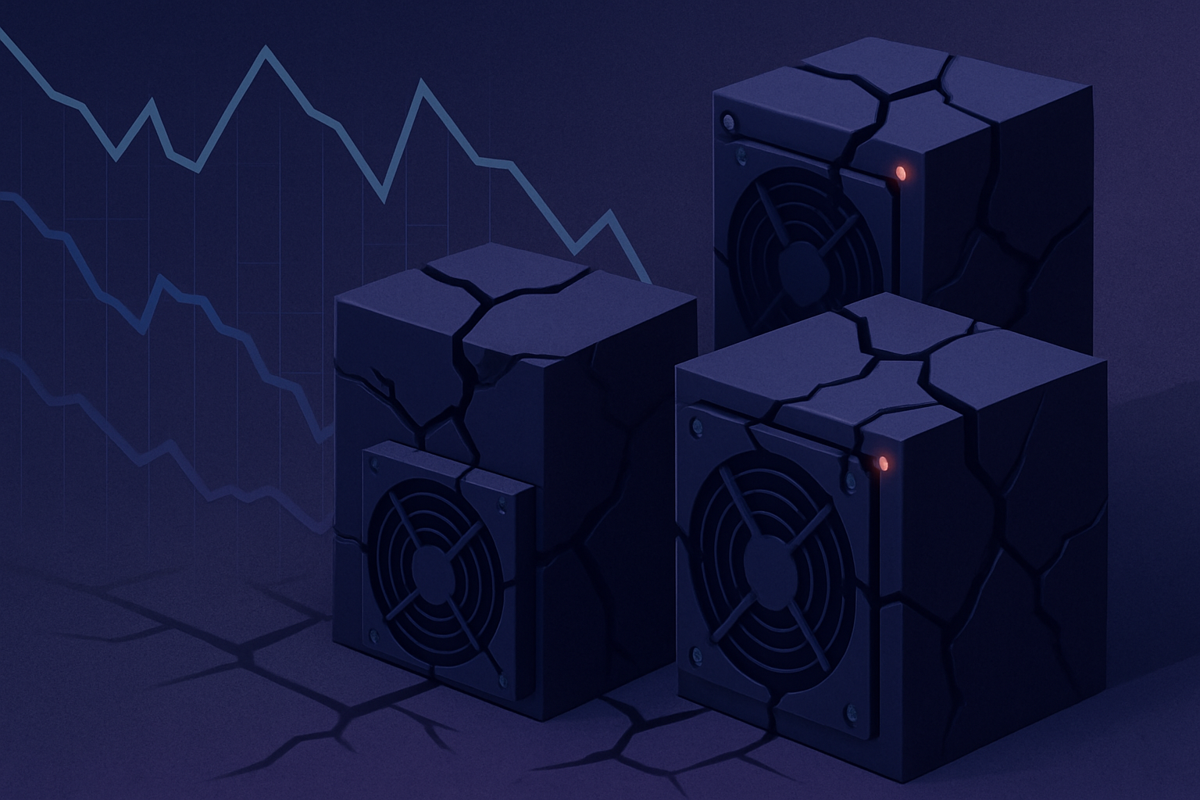
Bitcoin’s miners have always been the canaries in the digital coal mine. This week, they’re gasping for air. As of June 24, 2026, an estimated 20% of global mining operations are unprofitable at current prices, according to The Block. The headline number, Bitcoin plunging below $60,000, has triggered a margin squeeze that’s as much about survival as it is about price action. The market’s collective shrug is masking a slow-motion capitulation that could redraw the crypto landscape.
Let’s get granular. The past eight months have been a demolition derby for digital assets: over $2.2 trillion in market cap erased, Bitcoin down 53% from the highs, Ethereum off 67%. But the real pain is at the network level. Miner revenue has slipped below the average production cost, a threshold that historically signals forced selling, hash rate drop-offs, and, if it drags on, network instability. The last time this happened, we saw a cascade of bankruptcies and a fire sale of ASICs that made eBay look like a liquidation warehouse.
This isn’t just a crypto sideshow. Miners are the backbone of Bitcoin’s security model. When their margins evaporate, the incentives to support the network get shaky. The current squeeze is already visible in hash rate data: blocks are being found more slowly, and smaller operators are powering down rigs. The big industrial miners, Riot, Marathon, Bitfarms, are better capitalized, but even they’re trimming operations and selling coins to stay afloat. The upshot? Downward pressure on price, and a feedback loop that can get ugly fast.
The macro backdrop isn’t helping. The Fed’s hawkish pivot under new chair Kevin Warsh has hammered non-yielding assets across the board. Gold, silver, and Bitcoin all took a beating as traders recalibrated for higher-for-longer rates. The narrative that Bitcoin is a “digital gold” safe haven is being stress tested in real time. Meanwhile, institutional flows are a trickle compared to the 2021-2024 boom. The retail crowd is shell-shocked, and the only thing more illiquid than altcoins is the miners’ balance sheets.
Historically, miner capitulation has been a reliable signal for cycle bottoms. The 2018 and 2022 bear markets both ended with a wave of bankruptcies and hash rate resets. But this time, the scale is bigger. The halving earlier this year slashed block rewards, and the cost of energy isn’t coming down. Miners in high-cost jurisdictions are already unplugging, and the hash rate is trending lower for the first time since 2022. If the price stays below the breakeven threshold, estimated at $62,000, expect more forced selling and a scramble for market share among the survivors.
The knock-on effects are non-trivial. Miner selling can create supply overhangs that cap price rallies. If network security drops too far, the risk of 51% attacks, while still remote, increases. And if enough miners go under, the network could see a “death spiral” where difficulty adjusts downward, but price fails to recover quickly enough to lure new hash power back online. That’s the doomsday scenario, and while we’re not there yet, the risk is rising.
The opportunity? If you believe in mean reversion, miner capitulation is historically a buy signal. The survivors emerge leaner, the network consolidates, and price eventually recovers. But timing is everything. Knife-catching in a miner-driven selloff is a blood sport. The safer play is to wait for signs of stabilization, hash rate flattening, miner bankruptcies peaking, and price reclaiming key technical levels.
Strykr Watch
Technically, Bitcoin is hanging by a thread. The $60,000 level was crucial support, and the break below has opened the door to a test of $55,000, where the next cluster of bids sits. Resistance is now $62,000, the estimated average production cost for miners. RSI is oversold on the daily, but the momentum is still negative. Watch the hash rate charts: if the decline accelerates, expect more selling as miners liquidate reserves. If hash rate stabilizes and price reclaims $62,000, the worst may be over.
The bear case is brutal. If energy costs spike or the Fed doubles down on hawkish rhetoric, miner margins get squeezed even further. A wave of bankruptcies could trigger a cascade of forced selling, pushing price toward $50,000. The risk of network instability is low but rising. On the other hand, if Bitcoin can hold $55,000 and hash rate finds a floor, the stage is set for a relief rally as the weakest miners exit and the survivors consolidate power.
For traders, the playbook is clear: avoid leverage until the dust settles. Look for capitulation signals, spikes in miner outflows, hash rate troughs, and panic in mining stocks. If you’re nimble, there’s money to be made on the rebound. But don’t try to be a hero. The first bounce is rarely the bottom in a miner-driven selloff.
Strykr Take
Bitcoin’s miner margin squeeze is the story under the surface. Forced selling and hash rate declines are a toxic mix, but they also set the stage for the next cycle. Wait for capitulation, then pounce. Strykr Pulse 42/100. Threat Level 4/5.
Sources (5)
Bitcoin L2 DeFi: Why Overcollateralized Lending Beats the App Experiment
Teams building on Bitcoin L2 have spent two years running a collective experiment whose results now read clearly. The Ordinals inscription cycle, BRC-
Kevin Warsh's first Fed meeting sends gold, silver, and Bitcoin tumbling
Warsh's hawkish Fed stance highlights the vulnerability of non-yielding assets, prompting investors to reassess risk amid potential rate hikes. Kevin
“I Didn't Sell a Single ADA” Hoskinson Defends Cardano Commitment Since 2017
Cardano (ADA) founder Charles Hoskinson has reaffirmed his long-term commitment to ADA, emphasizing he has never sold any ADA since 2017.
Bitcoin miners face deepening margin squeeze as revenue falls below production costs
An estimated 20% of miners are now unprofitable at current prices, and the stress shows up at the network level, too.
Alchemy Pay gets Illinois license, reaches 18 states
Alchemy Pay that it secured a Money Transmitter License in Illinois, expanding its U.S. regulatory coverage to 18 states. The approval gives the compa