
Strykr Analysis
NeutralStrykr Pulse 58/100. Flat price action despite major catalysts signals apathy, not conviction. Threat Level 3/5.
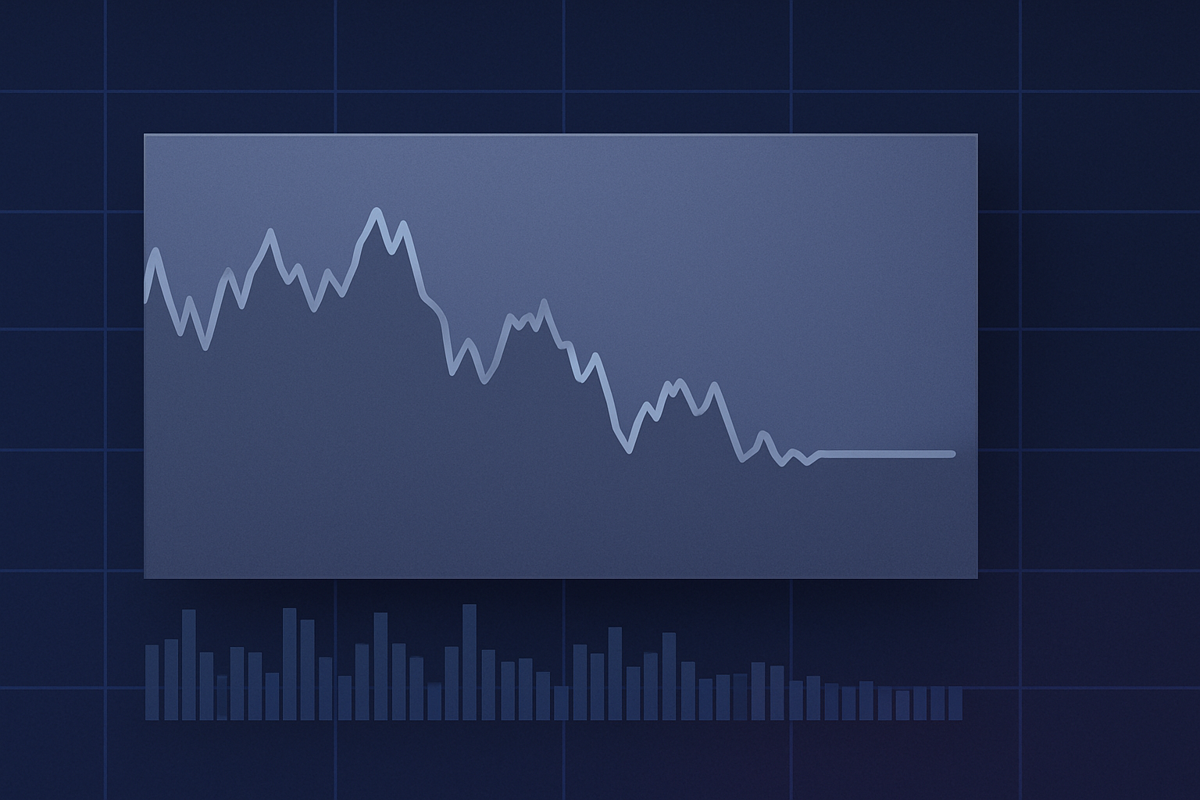
If you blinked, you missed it. The Strait of Hormuz is still a traffic jam, oil futures are twitchy, and yet the Invesco DB Commodity Index Tracking Fund ($DBC) is sitting at $29.17, as flat as a central banker's pulse. In a week where geopolitical risk should have sent commodity ETFs into orbit, $DBC is the kid at the party refusing to dance. For traders who have spent the last 48 hours glued to headlines about Iran, oil tankers, and the latest inflation scare, this lack of movement is more than a little absurd. The market is supposed to be a discounting machine, but right now, $DBC is acting like it forgot to plug itself in.
Let's run through the tape. The Strait of Hormuz, the world's most important oil chokepoint, is still mostly closed according to Seeking Alpha (2026-06-10). Oil supply disruptions are supposed to mean higher prices, right? And yet, $DBC is unchanged. Meanwhile, the Dow just had its worst day of 2026 (WSJ, 2026-06-10), as inflation and Middle East risk finally spooked the equity crowd. Commodities, in theory, should be the hedge. But the algos seem to have missed the memo, or maybe they're just too busy front-running each other in the S&P 500 futures pit.
Historically, $DBC has been a reliable barometer for cross-asset risk. When oil spikes, $DBC usually follows. But this time, the ETF is stuck in neutral. The last time the Strait of Hormuz was this hot, commodity indices surged double digits. Now, even with the threat of further US-Iran escalation, the market's collective yawn is deafening. The ETF's composition, energy, metals, agriculture, should make it sensitive to global supply shocks. Instead, it's behaving like a fixed income fund in a zero-vol world.
The context is even stranger when you look at cross-asset flows. With tech stocks wobbling and bond yields inching higher, you'd expect a rotation into hard assets. But the data says otherwise. According to recent flows tracked by Strykr Pulse, money is still dribbling out of commodities and into cash or, absurdly, back into US equities, despite the macro fireworks. Are traders so conditioned to buy the dip in stocks that they've forgotten commodities exist? Or is the market quietly betting that the Iran crisis fizzles out before the next OPEC meeting?
Some will argue that $DBC's flatline is a function of ETF mechanics. Maybe the underlying futures haven't caught up, or maybe the ETF's basket is hedged out by some quant desk in Stamford. But that doesn't explain the total lack of volatility. The VIX for commodities should be screaming, not whispering. It's as if the market is pricing in geopolitical risk with one hand and selling it with the other. Meanwhile, energy traders are left staring at a tape that refuses to move, wondering if the real action is happening in dark pools or off-exchange swaps.
This isn't just a technical story. The broader macro backdrop is a mess. Inflation is back in the headlines, with President Trump openly declaring his love for higher prices (CNBC, 2026-06-10). The Fed is under new management, and bondholders are demanding a focus on inflation (Barron's, 2026-06-10). Normally, this would be rocket fuel for commodities. But the market's reaction is muted, almost anesthetized. Maybe traders are over-hedged, or maybe they're just tired of chasing false breakouts. Either way, the lack of movement in $DBC is a warning sign. When the market stops reacting to obvious catalysts, it's usually a prelude to something bigger.
Strykr Watch
Technically, $DBC is boxed in a tight range. The $29.00 level has acted as a magnet for weeks, with resistance at $29.50 and support at $28.75. RSI is stuck near 50, signaling a market with no conviction. The 50-day moving average is flatlining, and volume has dried up. For momentum traders, this is purgatory. But for mean reversion specialists, the setup is almost too clean. If $DBC breaks above $29.50 on real volume, the next stop is $30.25. A breakdown below $28.75, and the ETF could unwind quickly to $27.80, especially if oil futures finally catch up to the geopolitical risk.
The risk, of course, is that the market is simply waiting for the next headline. If the Strait of Hormuz reopens or the Iran story fades, $DBC could drift lower on lack of catalysts. But if the crisis escalates, expect a violent repricing. The tape is coiled tight, and it won't take much to trigger a move.
The bear case is straightforward. If oil prices roll over, $DBC will follow. A surprise ceasefire in the Middle East, or a sudden drop in inflation expectations, could send the ETF back to its March lows. On the flip side, any escalation, real or perceived, will light a fire under the entire commodity complex.
For traders looking for opportunity, the playbook is simple. Buy the breakout above $29.50 with a tight stop at $29.10. Target $30.25 on a squeeze. For the bears, sell a breakdown below $28.75 with a stop at $29.20. Target $27.80 if the tape unravels. Don't overthink it. The market is giving you a gift: a tight range with clear levels and asymmetric risk.
Strykr Take
$DBC is the market's forgotten stepchild right now, but that won't last. The tape is too quiet, the range too tight, and the catalysts too obvious. When this breaks, it will break hard. This is a classic volatility compression setup, boring, until it isn't. Stay nimble, trade the range, and be ready to flip when the move comes. Strykr Pulse 58/100. Threat Level 3/5.
Sources (5)
Market Shifts From Risk On To Risk Off
David Keller on current market volatility. Narrow leadership creates challenging environment, with investors rotating from overextended growth stocks
Bitcoin bulls are still around. These charts show they just moved on to hotter markets.
Traders who once bet on crypto have not stopped gambling on the next big market story — they just are not finding that story in crypto itself.
Analysis: Trump said he loves inflation. Why that should be music to Kevin Warsh's ears
President Donald Trump appears to be doing a U-turn on his treatment of the Federal Reserve chair, now that Kevin Warsh has taken over from Jerome Pow
Just a matter of time before the Fed hikes, says fmr. Trump economist
Joe Lavorgna, SMBC Americas Managing Director & Chief Economist, Fmr. Counselor to Secretary Bessent, joins 'Fast Money' to talk the impact of inflati
EWZ: Brazilian Equities Still Have Upside, But The Trade Is Less Clean
Brazilian equities still look attractive versus U.S. markets, especially if global risk appetite improves. Brazil's domestic setup has become less cle