
Strykr Analysis
BullishStrykr Pulse 68/100. Geopolitical risk and infrastructure shocks are underpriced. Threat Level 4/5.
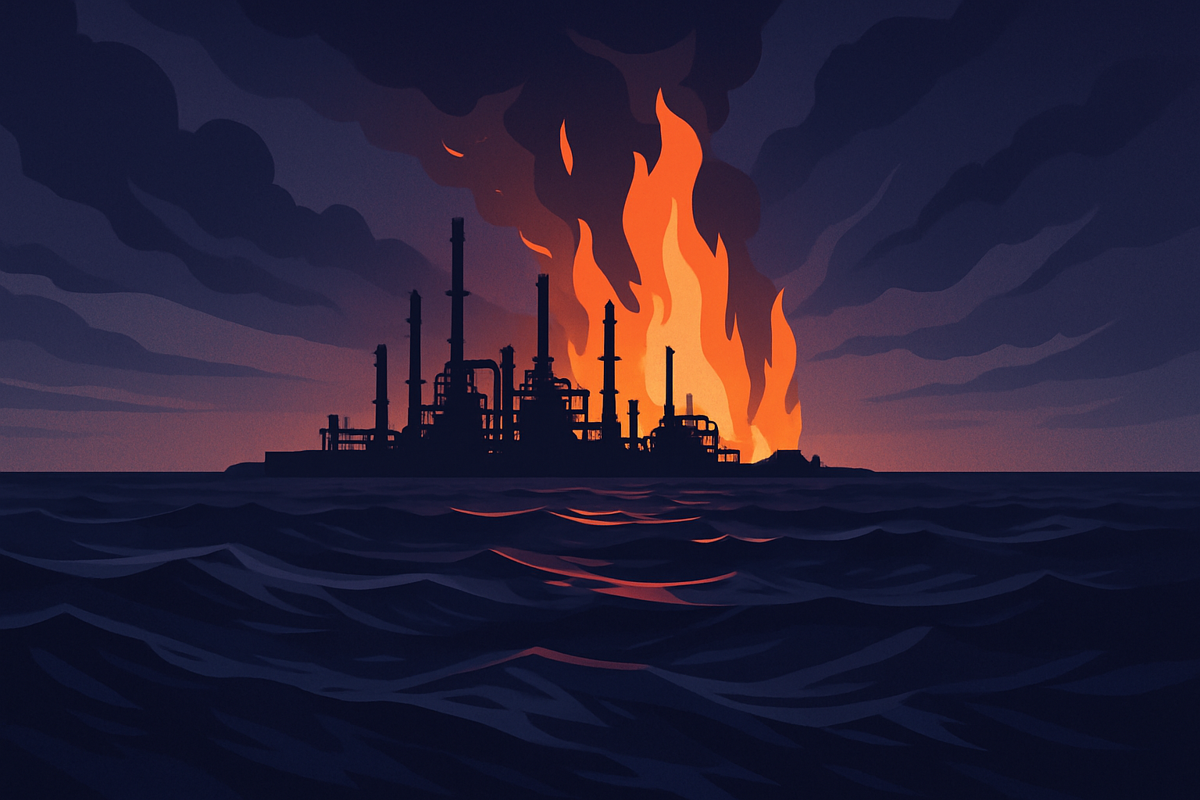
If you want to know what keeps oil traders up at night, forget OPEC meetings and ignore the latest EIA spreadsheet. The real action is a blend of geopolitics and infrastructure chaos, and this week’s cocktail is particularly combustible. As of June 25, 2026, the world’s most important energy chokepoint, the Strait of Hormuz, is back in the headlines, courtesy of Iran’s saber-rattling and a refinery fire in Pennsylvania that’s less Black Swan, more Black Smoke.
Let’s start with the facts. Monroe Energy’s Trainer refinery in Pennsylvania went up in flames, local media reported Thursday morning, sending a plume of uncertainty across refined product markets. Meanwhile, MarketWatch flagged that Iran is “tightening its grip” on the Strait of Hormuz, the narrow passage through which roughly 20% of global oil flows. If you’re looking for a reason why oil volatility is about to spike, you just found two.
Yet, in the ETF world, you’d never know it. DBC, the Invesco DB Commodity Index Tracking Fund, a bellwether for broad commodity sentiment, closed flat at $28.55. No panic, no euphoria, just a market that seems to have taken a Xanax. But under the surface, the risk premium is quietly rebuilding. The last time Iran flexed its muscles in the Strait, Brent crude spiked 14% in a single session. This time, the market is either asleep at the wheel or betting that the US Navy’s 5th Fleet is still the world’s best insurance policy.
The Trainer refinery fire is not a sideshow. US East Coast gasoline inventories are already running below their five-year average, and the region’s refining capacity has shrunk by nearly 30% over the past decade. A single plant going offline can ripple through the crack spread faster than you can say “RBOB futures.” The market’s apparent indifference is less a sign of resilience, more a symptom of summer complacency.
Zooming out, the macro backdrop is anything but dull. The Fed just gave US banks a clean bill of health in its 2026 stress test, which should be bullish for risk assets. But commodities are increasingly trading on their own idiosyncratic drivers, geopolitics, weather, supply chain hiccups, rather than the dollar or rates. That’s why DBC’s flatline is so deceptive. The ETF’s basket includes energy, metals, and ags, but right now, oil is the only story that matters.
Historically, the Strait of Hormuz has been the market’s favorite tripwire. In 2019, a series of tanker attacks sent oil up 10% overnight. In 2022, drone strikes on Saudi infrastructure briefly put $100 oil back on the table. The difference now is that spare capacity is thinner, inventories are lower, and the US Strategic Petroleum Reserve is still licking its wounds from last year’s drawdowns. The system is less shock-absorbent than it’s been in decades.
Iran’s motives are textbook: assert leverage ahead of US elections, extract concessions on sanctions, and remind the world that it can still move the price of oil with a few well-placed gunboats. The market’s muted reaction could be a case of “crying wolf” fatigue, but the risk is asymmetric. If even a single VLCC (Very Large Crude Carrier) gets delayed or, worse, attacked, the price response will be violent. Meanwhile, the Trainer refinery fire is a reminder that US infrastructure is not immune to its own black swans.
Strykr Watch
Technically, DBC is coiled like a spring. The ETF has been stuck in a tight range between $28.25 and $29.10 for weeks. RSI is neutral at 51, and 20-day volatility is scraping multi-year lows. But don’t let the calm fool you. The 200-day moving average sits at $28.80, a break above could trigger a momentum chase, especially if oil headlines escalate. On the downside, $28.25 is the line in the sand. Below that, you’re looking at a quick trip to $27.50. Watch the crack spread: if gasoline margins widen on the Trainer outage, energy’s weight in DBC could quietly drag the whole ETF higher.
The options market is starting to price in higher realized volatility for July and August. Implied vols on front-month DBC calls have ticked up to 18%, up from 14% last week. That’s not panic, but it’s the market’s way of buying insurance on the cheap. If you’re trading the ETF, keep an eye on open interest in the $29 and $30 calls, any spike there is your canary in the coal mine.
The risk, of course, is that the market keeps sleepwalking until it doesn’t. If Iran escalates or the refinery outage drags on, the move will be fast and disorderly. Don’t expect to catch the first 3%, the algos will front-run you. But the setup is there for a volatility regime shift.
On the bear side, if the Trainer fire is contained quickly and Iran backs off, the risk premium will evaporate. DBC could drift back to the lower end of its range, and the summer doldrums will resume. But that’s not the way to bet right now.
For traders, the opportunity is in the options market. Buy cheap volatility while you still can. If you’re directional, look for a breakout above $28.80 to ride the momentum. On the downside, a break below $28.25 is your stop. The risk-reward is finally tilting in favor of action.
Strykr Take
This is not the time to be lulled by ETF flatlines. The real story is brewing in the Strait of Hormuz and the US refining system. Complacency is the crowded trade. The next headline could turn this market on its head. Strykr Pulse 68/100. Threat Level 4/5.
Sources (5)
Open vs. Closed AI: What Advisory Firm Leaders Need to Know
Before your firm starts using AI across operations, client service, reporting, or advisor workflows, there's one basic question leadership needs to an
Large fire burns at Trainer refinery in Pennsylvania, local media reports
A large fire is burning at Monroe Energy LLC's Trainer refinery in Pennsylvania, local media reported on Thursday.
Iranian leader scoffs at Trump claim that Iran must buy U.S. farm products with unfrozen assets
The speaker of Iran's parliament called into question U.S. claims that the Islamic Republic's unfrozen assets will be used to purchase U.S. agricultur
Take a cue from the rich: Do a midyear financial check-in
Financial advisers would tell you to rebalance your portfolio at a midyear check-in. Make these 4 money moves instead.
2026 Fed Stress Test: Banks Got Their Green Light
All 32 major U.S. banks passed the 2026 Fed stress test, confirming strong capital resilience even under severe economic scenarios. The Fed's freeze o