
Strykr Analysis
NeutralStrykr Pulse 58/100. Market is complacent, but the risk of a supply shock is real. Threat Level 3/5.
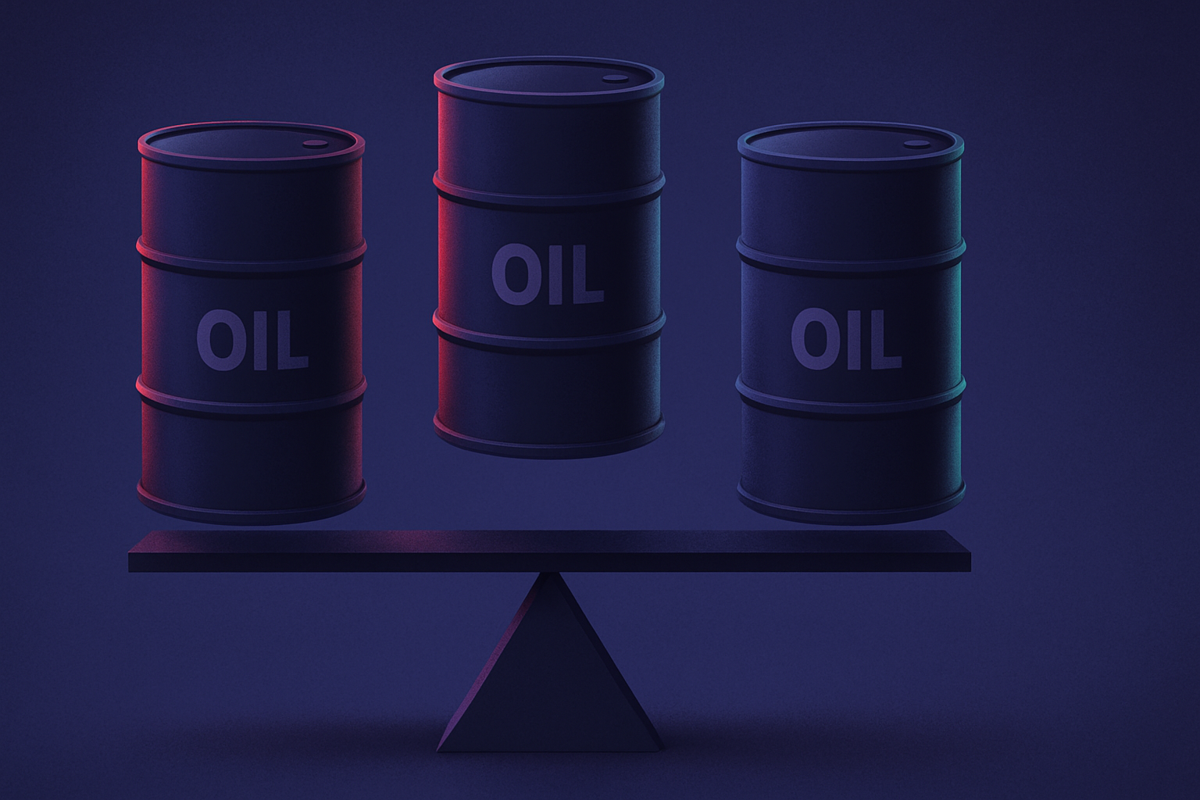
If you’re looking for textbook market absurdity, look no further than the oil complex this week. The Strait of Hormuz is a geopolitical powder keg, the U.S. and Iran are trading live fire, and President Trump is on TV declaring American forces have the world’s most strategic oil chokepoint under control. So why are oil prices not only failing to spike, but actually slipping? Welcome to 2026, where the only thing more reliable than Middle East tension is the market’s ability to ignore it, until it can’t.
As of 09:31 UTC, the Invesco DB Commodity Index Tracking Fund ($DBC) is flat at $29.17. Brent and WTI futures, which should be rallying on any whiff of Gulf disruption, are instead meandering lower, according to Barron’s and the Wall Street Journal (2026-06-11). U.S. stock futures are up, as if the world’s oil supply is just another line item in a spreadsheet. The market’s message: don’t panic, Trump’s got this. But history says that’s a dangerous game.
Let’s run the tape. Overnight, CENTCOM confirmed fresh U.S. strikes on Iranian targets. Iranian proxies lobbed missiles at Gulf shipping lanes. Trump, never one to underplay a hand, told the world that the U.S. “controls” the Strait of Hormuz. Oil initially popped, then reversed. By the European open, crude was down, not up. The algos, it seems, have decided that geopolitical risk is just noise, until it isn’t.
This isn’t the first time oil traders have whistled past the graveyard. In 2019, drone attacks on Saudi facilities sent crude up +15% in a day, only to see the move retraced within a week. In 2024, Red Sea shipping disruptions barely registered. The difference now is that the market is even more complacent. Volatility in oil options is scraping multi-year lows. Speculative positioning is light. The crowd is leaning short volatility, betting that the U.S. Navy can keep the world’s oil flowing no matter what.
But the fundamentals tell a different story. The Strait of Hormuz handles roughly 20% of global oil flows. Any sustained disruption would be catastrophic for supply chains, especially with OPEC+ already running tight quotas and U.S. shale growth plateauing. Inventories are low, spare capacity is thin, and the world is one missile away from a true supply shock. Yet, here we are, with $DBC flatlining and crude drifting lower.
Part of the story is macro. With inflation data in focus and Treasury yields steady (CNBC, 2026-06-11), traders are more worried about the Fed than the IRGC. The oil market, always the first to sniff out recession risk, is discounting demand destruction before it even happens. The other part is structural. Passive flows dominate, and the volatility sellers are in charge. Until they aren’t.
For traders, the setup is classic complacency. The market is pricing in perfection, assuming that U.S. control of Hormuz is ironclad and that Iran won’t escalate. But the risk is asymmetric. If the situation deteriorates, a mine, a missile, a tanker seized, oil could gap higher in a heartbeat. The options market is cheap, and the crowd is offsides. If you’re looking for a catalyst, this is it.
Strykr Watch
Technically, $DBC is stuck in a tight range, with $29.00 as near-term support and $29.50 as resistance. Momentum is neutral, with RSI at 47. The 50-day moving average is flatlining, and volume is anemic. If oil breaks above $29.50, look for a squeeze toward $30.00. Below $29.00, the next real support doesn’t show up until $28.40. Options skew is historically low, making long volatility trades attractive. Watch for a spike in volume or a sudden move in Brent/WTI spreads as the canary for a regime shift.
The bear case is that the market is right, Trump’s saber-rattling is just noise, and oil supply is secure. The bull case is that the market is asleep at the wheel, and any real disruption will force a violent repricing. For now, the technicals say “wait and see,” but the setup is ripe for a surprise.
The risk is obvious: a real escalation in the Gulf that takes oil off the market. But there’s also the risk of a macro shock, if inflation re-accelerates or the Fed surprises hawkish, oil could get hit from both sides. For now, the market is pricing in neither.
On the opportunity side, traders willing to pay for optionality could be rewarded. Long volatility trades, calls, straddles, or outright long $DBC, are cheap. If oil breaks out, the move could be fast and disorderly. For the patient, buying dips near $29.00 with tight stops offers a defined risk-reward. For the bold, a short volatility play is a crowded trade begging to be squeezed.
Strykr Take
This is the kind of setup that makes or breaks a quarter. The market is sleepwalking through the world’s most dangerous oil chokepoint, and the crowd is offsides. If you’re not positioned for a volatility spike, you’re betting that nothing will go wrong. That’s a brave bet, but not a smart one. Strykr Pulse 58/100. Threat Level 3/5. Optionality is cheap, and the risk is anything but.
Sources (5)
Trump Says U.S. Controls Strait of Hormuz Amid Iran Strikes. Oil Prices Slip.
Brent crude and WTI prices were edging down early on Thursday as the U.S. and Iran exchanged strikes and President Trump said American forces control
Shin-Etsu to build new rare earth refining facility amid China's export control
Japanese rare earth magnet manufacturer Shin-Etsu Chemical plans to build a new rare earth refining facility in Fukui prefecture in western Japan to
Treasury yields steady as investors monitor inflation data, U.S. strikes in Iran
U.S. Treasurys steadied Thursday, as investors monitored developments in the Middle East conflict ahead of further inflation data.
Oil Falls Despite Fresh U.S. Military Action on Iran; U.S. Futures Rise
U.S. stock futures were higher Thursday after tech-related losses and inflation data hurt markets in the previous session.
Probably a Bit More Markets Pain Ahead: 3-Minutes MLIV
Anna Edwards, Guy Johnson and Mark Cudmore break down today's key themes for analysts and investors on "Bloomberg: The Opening Trade." Chapters: 00:00