
Strykr Analysis
NeutralStrykr Pulse 54/100. The tape is dead flat, but risk is quietly building. Threat Level 3/5.
If you’re looking for fireworks in commodities, you’ll have to wait. The Invesco DB Commodity Index Tracking Fund ($DBC) has spent the past 24 hours glued to $29.24, a price level so stubborn it would make even the most seasoned range trader yawn. But don’t mistake this dead calm for safety. When volatility vanishes, it’s often the market’s way of catching its breath before something snaps.
The facts are stark. $DBC hasn’t budged, not even a cent, despite a backdrop that should have traders on edge. Global supply chains are still a mess, thanks to ongoing Middle East tensions and a fresh round of Israeli airstrikes on Iran. Jet fuel costs are surging, according to Reuters, and China’s export engine is sputtering as demand from Western consumers dries up. Yet the broad commodity basket, oil, metals, ags, hasn’t moved. Flat as a pancake.
This isn’t just a one-day phenomenon. Over the past week, $DBC has been locked in a tight range, ignoring every macro headline tossed its way. No response to the sharp NASDAQ and SOX selloff Friday. No reaction to the German factory order slump. Not even a twitch after last week’s jobs report sent bond yields spiking and triggered a risk-off scramble in equities. It’s as if the entire commodity market is on strike, refusing to play its usual role as the world’s volatility engine.
Historically, this kind of stillness is rare. Commodities are supposed to be the canary in the coal mine for inflation, geopolitical shocks, and supply disruptions. When the rest of the market is jittery, commodities usually spike or plunge, not nap. The last time we saw $DBC this inert was in the summer of 2019, right before the US-China trade war escalated and sent oil and metals on a wild ride. Back then, the calm lasted just long enough for traders to get complacent. Then the bottom dropped out.
So what’s different this time? For one, the market is grappling with cross-currents that are hard to price. On one side, you have surging input costs, energy, shipping, labor, thanks to the Iran war and persistent inflation. On the other, demand is rolling over in Europe and China, with German factory orders falling and Chinese exports stalling. The result: a standoff. Bulls and bears are both paralyzed, waiting for the other side to blink.
There’s also the ETF effect. $DBC is a basket of futures contracts, and in periods of extreme backwardation or contango, the roll yield can sap returns or juice them, regardless of spot price moves. Right now, with oil curves flattening and metals in a holding pattern, there’s little incentive for big money to pile in. The algos are content to let the tape drift sideways, waiting for a catalyst.
But catalysts are brewing. The next US inflation print is lurking, and the Fed’s hawkish stance means any upside surprise could light a fire under commodities. Meanwhile, the Iran conflict isn’t going away, and any escalation could send oil and energy names ripping higher. On the flip side, if demand in Europe and China continues to crater, the whole complex could roll over fast. This is a market that’s coiled, not dead.
Strykr Watch
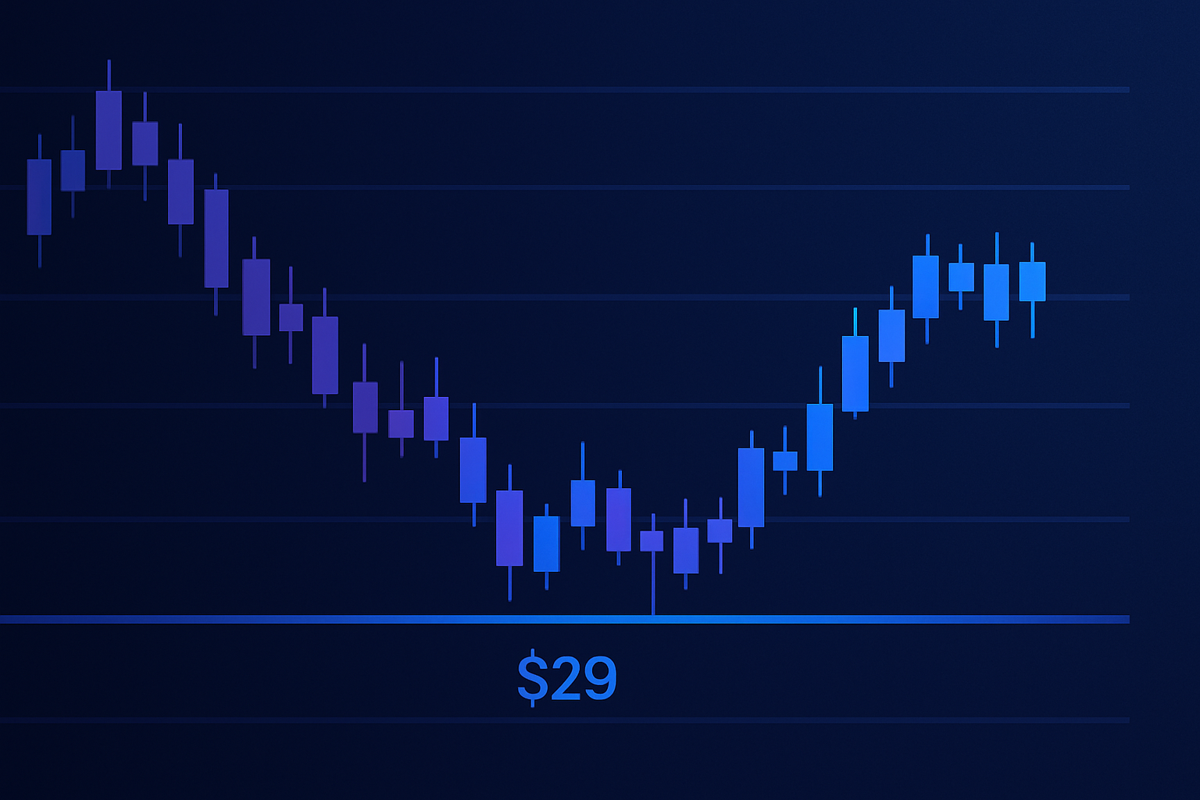
Technically, $DBC is boxed in between $29 support and $30 resistance, a range that’s held for weeks. The 50-day moving average sits just below at $28.90, providing a soft floor. RSI is neutral, no overbought or oversold signals here. Volume has dried up, a classic sign of indecision. If $DBC breaks above $30, there’s room to run to $31.50 (April highs). A break below $28.90 opens the door to $27.80 (March lows). Until then, it’s a waiting game.
The real tell will be how $DBC reacts to the next big macro shock. If oil spikes on Middle East headlines and $DBC can’t catch a bid, that’s a red flag. If the ETF jumps on a hot CPI print, it’s a sign the inflation hedge is alive and well. Watch for volume to pick up, when it does, the range will break.
Risk is building under the surface. The longer volatility stays suppressed, the bigger the move when it returns. Traders should keep stops tight and position sizes modest. This is not the time to get greedy.
On the opportunity side, nimble traders can fade the range, short at $30, long at $29, until the breakout comes. But be ready to flip fast. When $DBC finally moves, it could be violent. Longer-term, a sustained break above $30 would signal renewed inflation fears and a rush back into commodities. On the downside, a flush below $28.90 could trigger a cascade of selling as risk parity funds unwind.
Strykr Take
This is the kind of market that lulls you to sleep, then eats your lunch. Don’t mistake the flatline for safety. $DBC is coiled tight, and when it moves, it won’t be gradual. My bet: the next macro shock, whether it’s a Fed surprise, a Middle East escalation, or a sudden demand collapse, will break the range. Stay nimble, keep your stops tight, and don’t get caught napping. This is the calm before the storm, not the end of volatility.
datePublished: 2026-06-08 07:01 UTC
Sources (5)
German Factory Orders Fell Back in April
German manufacturing orders dropped in April, reversing some of the gains in March that came on the back of stock building after the outbreak of the w
A Critical Week For The Markets Ahead
Markets face a pivotal week after a strong jobs report, surging yields, and a sharp NASDAQ and SOX selloff on Friday signalled heightened volatility.
Inflation Is an ‘Economic Thief.' What Will the Fed Do About It?
As the U.S. learned in 2021 and 2022, there are financial and even political consequences when policymakers fail to act in response to inflation.
SaaS-Pocalypse
Despite generally strong fourth quarter earnings, the sharp declines have pushed software valuations to levels not seen in more than 15 years. Baron D
China's global e-commerce push stalls as Iran war lifts costs, dampens demand
China's e-commerce export engine is faltering as surging jet fuel costs and weak demand from lower-income consumers in the West linked to the Iran wa